
Cooking Oil Adulteration and Health Effects: A Detailed Public Health Guide
Dr JK Avhad MBBS MD [Last updated 05.01.2026]
Cooking oil is a daily dietary staple in almost every household. From frying to salad dressings and processed foods, oils contribute a significant portion of daily calorie and fat intake. Because of this widespread and frequent consumption, adulteration of cooking oil poses a serious and often underestimated public health risk. Unlike occasional food contamination, adulterated cooking oil can expose individuals to harmful substances daily for years, leading to chronic health problems that often go undiagnosed.
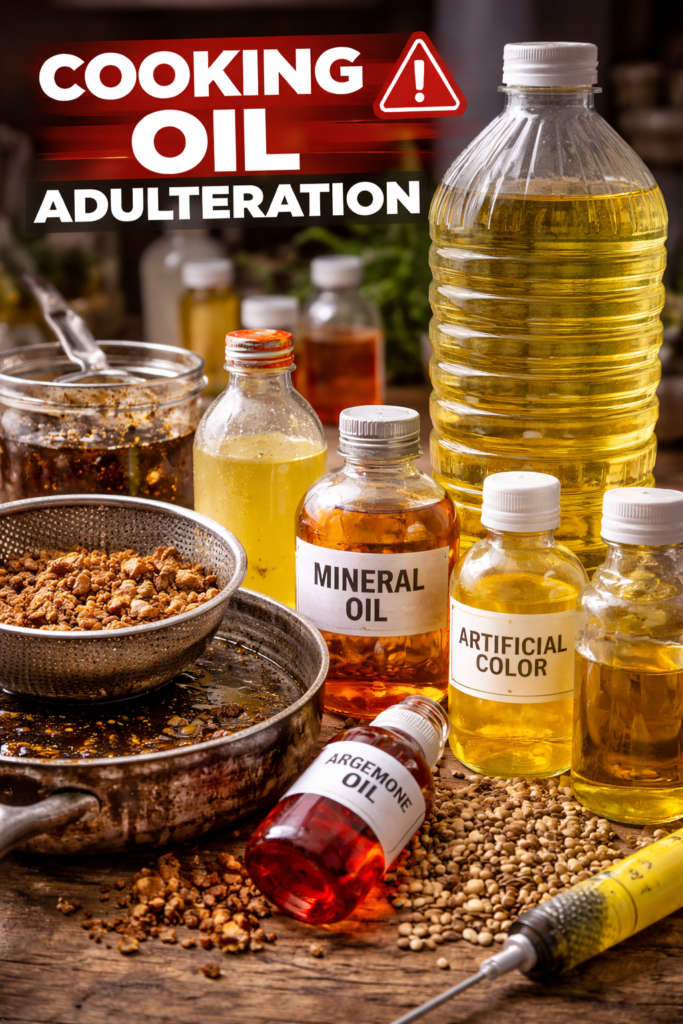
Cooking oil adulteration involves the intentional mixing of inferior, cheaper, or harmful substances to increase profit. These may include recycled or repeatedly heated oils, mineral oils, artificial colors, argemone oil, cottonseed oil, or industrial-grade oils. While regulatory systems in the United States are relatively strong, adulterated oils still enter supply chains through imports, informal markets, mislabeled blends, and food service misuse.
According to the World Health Organization, food adulteration is a major contributor to non-communicable diseases globally. The Centers for Disease Control and Prevention and National Institutes of Health emphasize that long-term exposure to contaminated dietary fats can increase risks of cardiovascular disease, liver toxicity, metabolic disorders, and cancer.
[Also read: Health Effects of Mosquito Coil Smoke in Children: What Parents Should Know]
[Click here: https://healthconcise.com/health-effects-of-mosquito-coil-smoke-in-children-what-parents-should-know/]
Defination:
Cooking oil adulteration refers to the deliberate addition or substitution of non-declared, inferior, or toxic substances into edible oils. The goal is usually economic—reducing production costs or increasing volume—at the expense of consumer health.
Adulteration may occur at:
- Production or refining stage
- Import and export chains
- Wholesale and retail distribution
- Food service and street food preparation
Because oils are visually similar and chemically complex, adulteration is difficult to detect without laboratory testing, making consumers particularly vulnerable.
Common Types of Cooking Oil Adulteration
1. Reused and repeatedly heated oil
One of the most widespread forms of adulteration is the reuse of cooking oil multiple times, especially in restaurants and street food settings.
Health concern:
Repeated heating causes:
- Formation of trans fats
- Lipid peroxides
- Aldehydes and free radicals
These compounds are strongly associated with:
- Atherosclerosis
- Chronic inflammation
- Insulin resistance
2. Argemone oil contamination
Argemone oil, extracted from Argemone mexicana seeds, has been historically used to adulterate mustard and other oils.
Health effects:
- Epidemic dropsy
- Severe edema
- Heart failure
- Glaucoma
Argemone oil toxicity has caused large-scale outbreaks of illness and death in documented cases.
3. Mineral oil adulteration
Mineral oils are petroleum-derived substances not intended for human consumption.
Why it’s used:
Cheap, colorless, odorless, and mimics edible oil texture.
Health risks:
- Accumulation in liver and lymph nodes
- Chronic liver inflammation
- Possible carcinogenic effects
The WHO classifies certain mineral oil hydrocarbons as substances of concern for long-term human exposure.
4. Artificial coloring agents
Synthetic dyes such as Sudan dyes are sometimes added to enhance color and mimic premium oils.
Health risks:
- Genotoxicity
- Liver damage
- Increased cancer risk
Sudan dyes are banned in food products in the U.S. and many countries.
5. Cottonseed oil
Higher-value oils like olive oil or mustard oil may be diluted with cheaper oils without disclosure.
Potential issues:
- Allergen exposure
- Imbalanced omega-6 to omega-3 ratio
- Increased inflammatory burden
6. Industrial or non-food-grade oils
In extreme cases, industrial lubricants or transformer oils have been reported in adulteration scandals.
Health impact:
Severe toxicity, neurological damage, organ failure.
Adverse effects on Human Body
1. Digestive system effects
Early exposure may cause:
- Indigestion
- Abdominal discomfort
- Acid reflux
- Chronic gastritis
Oxidized fats damage the intestinal lining and alter gut microbiota.
2. Liver toxicity and fatty liver disease
The liver metabolizes dietary fats. Adulterated oils overload detoxification pathways, leading to:
- Elevated liver enzymes
- Non-alcoholic fatty liver disease (NAFLD)
- Fibrosis with long-term exposure
The NIH identifies poor-quality dietary fats as a major contributor to NAFLD prevalence.
3. Cardiovascular disease risk
Adulterated oils contribute to:
- Increased LDL cholesterol
- Reduced HDL cholesterol
- Endothelial dysfunction
Repeated exposure accelerates plaque formation and raises the risk of:
- Heart attacks
- Stroke
- Hypertension
The CDC links trans fats and oxidized oils to increased cardiovascular mortality.
4. Metabolic disorders and diabetes
Oxidative stress from adulterated oils interferes with insulin signaling, contributing to:
- Insulin resistance
- Type 2 diabetes
- Obesity
5. Cancer risk from long-term exposure
Certain adulterants and breakdown products are:
- Mutagenic
- Carcinogenic
Chronic ingestion has been associated with increased risks of:
- Liver cancer
- Gastrointestinal cancers
WHO reports emphasize dietary exposure to chemical contaminants as a modifiable cancer risk factor.
6. Neurological and developmental effects
Some industrial oils and contaminants may affect:
- Cognitive function
- Peripheral nerves
- Neurodevelopment in children
Children and pregnant individuals are particularly vulnerable.
Early Warning Signs
Adulterated cooking oil exposure often causes slow, nonspecific symptoms, making diagnosis difficult.
- Persistent digestive discomfort
- Unexplained fatigue
- Headaches after meals
- Skin problems (acne, eczema)
- Gradual weight gain or metabolic changes
If multiple family members develop similar symptoms, dietary sources should be evaluated.
High-Risk Groups
According to the CDC and WHO, the following groups are at higher risk:
- Children
- Pregnant individuals
- Elderly adults
- People with liver, kidney, or heart disease
Restaurants and street food vendors may:
- Reuse oil beyond safe limits
- Mix fresh oil with old oil
- Use non-food-grade oils
Repeated heating significantly increases toxic compound formation. Consumers should be cautious with:
- Deep-fried foods
- Reused frying oil smell (rancid or acrid)
Ways to Reduce Exposure
1. Buy from reputable brands
- Look for proper labeling
- Avoid unusually cheap oils
2. Avoid excessive fried foods
- Especially from unknown sources.
3. Rotate oil types
- Avoid over-reliance on a single oil.
4. Store oils properly
- Heat, light, and oxygen accelerate oil degradation.
5. Do not reuse oil at home
- Repeated heating increases toxicity.
Public Health and Regulatory Perspective
The WHO, CDC, and FDA emphasize:
- Supply chain monitoring
- Laboratory surveillance
- Consumer education
Food adulteration undermines trust and contributes significantly to chronic disease burden.
Conclusion
Cooking oil adulteration is a silent but serious threat to public health. Because oils are consumed daily, even low-level contamination can accumulate over time, leading to liver disease, heart disease, metabolic disorders, and increased cancer risk. The health effects are often subtle at first, delaying diagnosis and intervention.
Scientific evidence from global and U.S. health agencies shows that adulterated and repeatedly heated oils generate toxic compounds that disrupt normal metabolism and promote chronic inflammation. Children, pregnant individuals, and people with existing medical conditions are particularly vulnerable.
Preventing harm requires a combination of consumer awareness, regulatory enforcement, and safer dietary practices. Choosing high-quality oils, avoiding excessive fried foods, and limiting oil reuse are practical steps that can significantly reduce risk. Protecting dietary fat quality is not just a culinary issue—it is a long-term investment in metabolic and cardiovascular health.
[Also read: What Are the Early Warning Symptoms of Milk Adulteration Exposure That Americans Should Not Ignore?]
This article is for informational purpose only and does not substitute for professional medical advise. For proper diagnosis and treatment seek the help of your healthcare provider.
References:
- World Health Organization. (2023). Food safety and food adulteration.
- World Health Organization. (2022). Chemical hazards in food.
- Centers for Disease Control and Prevention. (2024). Dietary fats and cardiovascular health.
- National Institutes of Health. (2023). Nonalcoholic fatty liver disease.
- U.S. Food and Drug Administration. (2023). Food adulteration and misbranding.
- Mozaffarian, D., et al. (2006). Trans fatty acids and cardiovascular disease. New England Journal of Medicine, 354, 1601–1613.
- Choe, E., & Min, D. B. (2006). Mechanisms of antioxidants in oil oxidation. Journal of Food Science, 71(5).
- Grootveld, M., et al. (2014). Health effects of oxidized frying oils. Food & Function, 5(5), 820–830.
- WHO & FAO. (2019). Dietary fats and health.
- Gupta, R. C. (2018). Reproductive and developmental toxicology. Academic Press.
- Liu, J., et al. (2017). Mineral oil hydrocarbons in food. Food and Chemical Toxicology, 109.
- EFSA Panel on Contaminants. (2012). Scientific opinion on mineral oils in food.
- Smith, K. R., et al. (2014). Food contamination and chronic disease risk.
- American Heart Association. (2022). Dietary fats and heart disease.
- Landrigan, P. J., et al. (2018). Pollution and global health. The Lancet.
- FAO. (2020). Food fraud and authenticity.
- Sharma, V., et al. (2021). Cooking oil adulteration and health impacts. Journal of Food Safety.