
Adverse Health Effects of Burning Incense Sticks (Agarbatti) in Poorly Ventilated Rooms
Dr JK Avhad MBBS MD [Last updated 07.01.2026]
Agarbatti (incense sticks) are used worldwide for religious rituals, aromatherapy, relaxation, and insect-repellent purposes. In many homes and places of worship they are burned daily or during prolonged ceremonies, often indoors and — critically — in spaces with poor ventilation. While their fragrant smoke is culturally familiar and often perceived as harmless, scientific research shows that burning incense produces a complex mix of particulate matter (PM), gases, and organic compounds known to damage the respiratory and cardiovascular systems, disrupt the developing nervous system, and increase long-term cancer risk when exposure is frequent and unventilated. In the United States, where indoor air quality and chronic disease are high-priority public-health concerns, understanding the risks from incense smoke is essential for clinicians, public-health practitioners, and consumers.
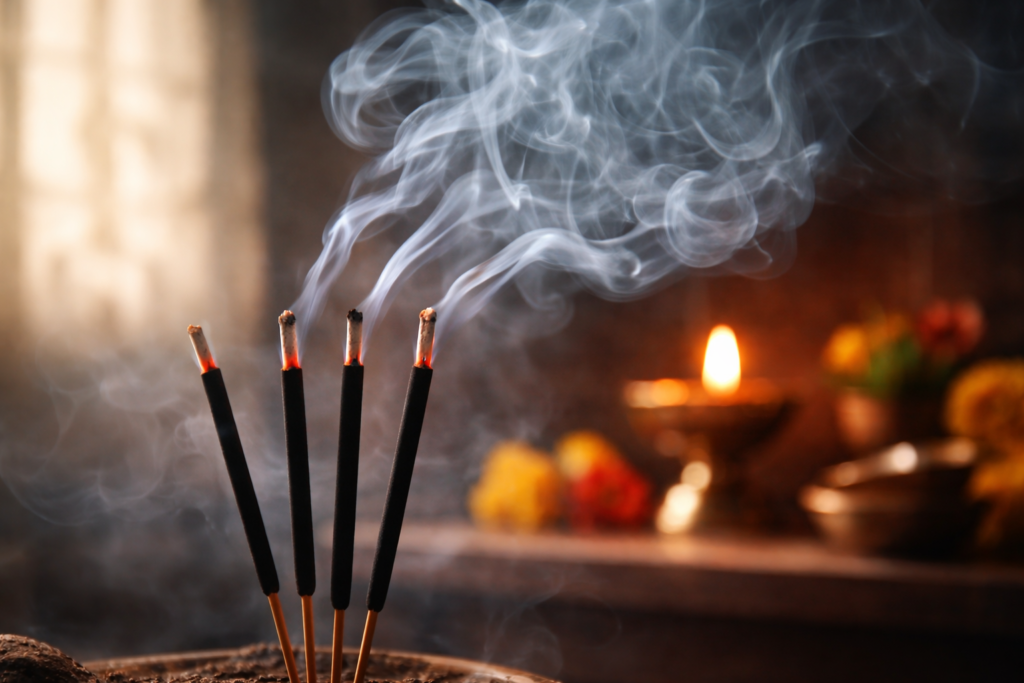
Incense sticks are made from a combustible base (bamboo or charcoal), powdered wood or herbal material, adhesives and a fragrant mixture of resins, essential oils, perfumes, dyes and other additives. When burned, they emit:
- Particulate matter (PM): Primarily fine particles (PM2.5 and PM1) and ultrafine particles that penetrate deep into the lungs.
- Gaseous products: Carbon monoxide (CO), nitrogen oxides (NOx), and sulfur compounds depending on ingredients and combustion completeness.
- Volatile organic compounds (VOCs): Benzene, toluene, formaldehyde, acetaldehyde, and other aldehydes.
- Polycyclic aromatic hydrocarbons (PAHs): Some of which are known carcinogens (e.g., benzo[a]pyrene).
- Other toxicants: 1,3-butadiene and specific fragrance chemicals that can be irritants or sensitizers.
The exact emission profile depends on formulation, burning rate, enclosed volume, and ventilation. Several studies comparing burning of incense with other household combustion sources find that incense can be a major source of indoor PM2.5 and carcinogenic VOCs in a confined space. (Aerosol and Air Quality Research)
Contamination of [Also read: Water Bodies by Agricultural Pesticide and Herbicide Runoff — How Residues Concentrate in Animal Milk and Flesh and the Long-Term Human Health Consequences]
Typical indoor exposures
Indoor monitoring studies show that a single incense-burning episode in a small room can raise PM2.5 concentrations from background (often 5–20 µg/m³ indoors in non-smoking U.S. homes) to hundreds of µg/m³ for the duration of burning and several hours afterward. Peak short-term PM values recorded during burning events have reached several hundred to over 800 µg/m³ in field studies; even averaged over an hour, levels are often above WHO and U.S. EPA recommended limits for short-term exposure. Along with PM spikes, short-term peaks in formaldehyde, benzene and PAHs are routinely measured during indoor incense use. These pollutant levels are especially concerning in poorly ventilated rooms where dilution with outside air is minimal.
Fine (PM2.5) and ultrafine particles deposit in the distal airways and alveoli; ultrafine particles can translocate into the circulation and reach extrapulmonary organs (heart, brain). Particulates also act as carriers for surface-bound organic toxicants (PAHs, aldehydes), delivering them deep into lung tissue where they can produce oxidative stress, inflammation and DNA damage. This combination of particles and adsorbed toxicants is a central mechanism by which incense smoke produces both acute irritation and long-term disease risk.
Acute health effects
In a poorly ventilated room, burning incense commonly causes immediate symptoms in many people, particularly the sensitive:
- Eye, nose and throat irritation (scratchy throat, watery eyes, nasal congestion) due to aldehydes and particulate irritation.
- Coughing, wheeze and shortness of breath, especially in people with asthma or chronic obstructive pulmonary disease (COPD).
- Headaches, dizziness, or nausea from volatile compounds or CO in poorly ventilated spaces.
- Exacerbation of allergic rhinitis or dermatitis in those with predisposition to atopy.
Clinical and occupational reports (temple workers, incense manufacturers) frequently document these immediate symptoms; experimental inhalation studies with incense particulates and extracts show inflammatory responses in airway cells consistent with observed symptoms.
Respiratory disease
Epidemiologic research links habitual incense exposure to increased prevalence and severity of asthma symptoms, reduced lung function in children and adolescents, and chronic bronchitic symptoms in adults. Several cross-sectional and longitudinal studies — especially from regions with high indoor incense use — report exposure–response relationships: more frequent or longer burning is associated with higher rates of wheeze, asthma diagnoses, and lower FEV1 and FVC values in youth. Genetic susceptibility (detoxification enzyme polymorphisms) may modify risk. While many studies are region-specific (Asia and the Middle East), the biological mechanisms (oxidative stress, airway inflammation) are generalizable and relevant to U.S. populations that burn incense indoors.
Cardiovascular effects
Fine and ultrafine particles from combustion sources can trigger acute cardiovascular responses (blood pressure changes, endothelial dysfunction, increased coagulability) and contribute to longer-term atherosclerotic disease. Cohort analyses have associated long-term incense use in the home with increased cardiovascular mortality (including ischemic heart disease and stroke) in populations with habitual exposure. Although population-level U.S. data specific to household incense are limited, evidence from cohort studies in Asia and mechanistic data linking PM exposure to cardiovascular pathophysiology support concern, especially among older adults and people with preexisting heart disease.
Cancer risk
Incense smoke contains several compounds classified or suspected as carcinogens (benzene, 1,3-butadiene, PAHs, formaldehyde). Laboratory studies demonstrate mutagenicity of incense smoke extracts, and observational studies have suggested associations between long-term incense exposure and increased risks for lung cancer and certain upper-airway or head-and-neck malignancies. The epidemiologic evidence is mixed and still developing: some cohort and case–control studies find elevated risks, while others find weaker or no associations after adjusting for confounders. Nevertheless, established carcinogens present in measurable quantities in indoor air during burning (and the plausible biological pathway from inhalation to DNA damage) argue for a cautious, preventive approach to frequent indoor incense use.
Neurological & developmental concerns
Children and fetuses are more vulnerable to air pollutants because of higher ventilation per body weight and ongoing development. Evidence links prenatal and early-life exposures to combustion-related particulates and some VOCs with neurodevelopmental impacts (lower cognitive scores, behavioral problems) in other indoor exposure contexts; incense-specific studies have reported higher cord-blood IgE and associations with allergic sensitization. While direct, robust data on incense-related neurodevelopmental outcomes are limited, the presence of neurotoxicants and ultrafine particles that can reach the systemic circulation strengthens the plausibility of adverse effects, suggesting that pregnant women and households with infants should avoid routine indoor burning in poorly ventilated spaces.
Reproductive health and endocrine disruption
Some components of incense smoke have endocrine-disrupting properties in experimental systems or are associated with reproductive toxicity in occupational exposure studies. Epidemiological evidence specifically linking household incense burning with human reproductive outcomes is sparse, but given the presence of known endocrine-disrupting compounds in combustion emissions, minimizing exposure during pregnancy and around people trying to conceive is prudent.
Skin and allergic responses
Fragrance components and small particles can deposit on the skin and mucous membranes. Case reports and clinical series describe contact dermatitis, urticaria, and exacerbations of atopic eczema associated with incense smoke exposure. For people with fragrance sensitivity, even very low exposures can trigger symptomatic reactions.
Risk groups
- Infants and young children — higher intake per body mass and developmental vulnerability.
- Pregnant women — fetal development sensitivity.
- People with asthma, COPD, or cardiovascular disease — higher risk of exacerbation and acute adverse events.
- Older adults — higher baseline cardiovascular risk and decreased physiological reserves.
- Occupationally exposed persons (temple workers, incense manufacturers, ritual workers) — repeated, high-level exposure with demonstrated symptoms and biomarker changes.
In the U.S., these vulnerable groups are present in both immigrant and non-immigrant communities; culturally sensitive messaging about ventilation and exposure reduction is essential.
Mechanisms
Multiple lines of evidence point to converging mechanisms: particulate-induced oxidative stress (reactive oxygen species), airway and systemic inflammation, direct DNA damage from PAHs and aldehydes, and vascular effects from ultrafine particle translocation. These mechanisms explain short-term irritation and long-term endpoints such as chronic respiratory decline, atherosclerosis progression, and tumorigenesis observed in laboratory and epidemiologic studies.
A single brief incense episode in a well-ventilated room carries low risk for most healthy adults; the health concern grows with frequency (daily or many times per week), duration (prolonged burning), and poor ventilation (no exchange with outside air). Occupational exposures — for example temple priests exposed to multiple burning events per day — present clear evidence of higher pollutant doses and demonstrated clinical impacts. In U.S. households where incense is used daily in small, enclosed rooms (bedrooms, small living rooms), cumulative exposure can rival that of other recognized indoor pollution sources.
Ways to reduce exposure
- Stop burning indoors in small rooms: Avoid incense use inside bedrooms or any poorly ventilated space.
- If you burn, ventilate well: Open windows and use cross-ventilation or local exhaust fans during and for at least 30–60 minutes after burning.
- Limit frequency and duration: Reduce number of sticks and burn time; prefer short ceremonial use over habitual daily burning.
- Choose alternatives: Use electric diffusers with water-based essential-oil mixes (while noting some oils can also produce irritants), fresh flowers, or incense burned outdoors.
- Air cleaning: Use HEPA air purifiers sized for the room — they remove most PM2.5 (but not gases like formaldehyde), so combine with ventilation. Activated-carbon filters can reduce some VOCs.
- Protect vulnerable people. Pregnant individuals, infants, people with asthma or heart disease should avoid exposure entirely.
- Occupational controls. For temples and workplaces: improve building-level ventilation, schedule breaks to reduce continuous exposure, consider switching to low-emission products or alternative rituals.
Policy regulations
- Public education campaigns targeted to communities where indoor incense is common, emphasizing ventilation and vulnerable groups.
- Guidance for places of worship and cultural institutions to adopt ventilation standards and work-practice controls for staff and volunteers.
- Inclusion of incense in indoor air quality assessments and public-health surveillance where relevant.
- Clinical screening: clinicians should ask about incense and other indoor-combustion exposures during respiratory or cardiovascular assessments, especially in patients with refractory symptoms.
- Research funding for prospective cohort studies in diverse populations and intervention trials (ventilation/air cleaners) to quantify risk reduction.
Because incense burning is deeply rooted in spiritual and cultural practices, messaging should be respectful and pragmatic: recommend ventilation and alternatives rather than prohibition, emphasize protection for children and pregnant people, and offer affordable mitigation measures (open windows, portable HEPA cleaners). Partnering with community leaders and faith organizations increases acceptance of safer practices.
Conclusion
Burning incense sticks produces a complex mix of fine particles and toxic gases that, in poorly ventilated rooms, can create pollutant concentrations high enough to cause acute irritation and to contribute to long-term respiratory, cardiovascular, and potential carcinogenic risks. While cultural and spiritual practices make incense use widespread and meaningful, a precautionary approach — especially for infants, pregnant people, those with respiratory or heart disease, and occupationally exposed workers — is warranted. Improved ventilation, limiting frequency and duration, using HEPA and activated-carbon filtration, and substituting non-combustion alternatives can substantially reduce risk while preserving ritual and sensory value. Public-health outreach, product testing, and further research are needed to quantify long-term risks in diverse U.S. populations and to guide culturally sensitive risk-reduction strategies.
[Also read: Cooking Oil Adulteration and Health Effects: A Detailed Public Health Guide]
[Click here: https://healthconcise.com/cooking-oil-adulteration-and-health-effects-a-detailed-public-health-guide/]
This article is for informational purpose only and does not substitute for professional medical advise. For proper diagnosis and treatment seek the help of your healthcare provider.
References:
- Lee, C. W., & others. (2021). The Adverse Impact
of Incense Smoke on Human Health. Environmental Health and Preventive
Medicine. https://pmc.ncbi.nlm.nih.gov/articles/PMC8548258/. PMC
- Tran, L. K., et al. (2021). The impact of incense
burning on indoor PM2.5 concentrations. Atmospheric Environment. ScienceDirect
- Tang, H. W., et al. (2024). Association Between
Incense Burning and the Risk of Lung Cancer. [Article]. https://pmc.ncbi.nlm.nih.gov/articles/PMC11671240/. PMC
- Chen, Y. C., et al. (2016). Adolescent lung function
associated with incense burning. Environmental Research. https://pmc.ncbi.nlm.nih.gov/articles/PMC5484285/. PMC
- Qin, Y. (2025). Invited Perspective: Incense Burning
and Cardiovascular Health. Environmental Health Perspectives. https://pmc.ncbi.nlm.nih.gov/articles/PMC11758983/. PMC
- World Health Organization. (2025). Household air
pollution and health (fact sheet). https://www.who.int/news-room/fact-sheets/detail/household-air-pollution-and-health. World Health
Organization
- U.S. Environmental Protection Agency. (n.d.). Candles
and Incense as Potential Sources of Indoor Air Pollution (report). https://nepis.epa.gov/Exe/ZyPURL.cgi?Dockey=P1009BZL.TXT. EPA Nepis
- Lin, T. C., et al. (2008). Incense smoke: clinical,
structural and molecular effects on airway disease. American Journal
of Respiratory and Critical Care Medicine. https://pmc.ncbi.nlm.nih.gov/articles/PMC2377255/. PMC
- Navasumrit, P., et al. (2008). Potential health
effects of exposure to carcinogenic emissions from incense. Toxicology
Letters. ScienceDirect
- Pan, A., et al. (2014). Incense use and
cardiovascular mortality among Chinese in Singapore: The Singapore Chinese
Health Study. Environmental Health Perspectives, 122, 1279–1284. https://pmc.ncbi.nlm.nih.gov/articles/PMC4256695/. PMC
- Alfano, R., et al. (2020). Review: Incense burning
and indoor air quality. (review and monitoring studies). Aerosol and Air
Quality Research
- Zeng, L., et al. (2023). Contributions of Indoor
Household Activities to Inhalation Cancer Risk. Aerosol and Air
Quality Research. https://aaqr.org/articles/aaqr-23-03-oa-0063.pdf. Aerosol and Air
Quality Research
- World Health Organization Commission on Health and Environment. Indoor air and health (Chapter reference). apps.who.int