
Health Effects of Mosquito Coil Smoke in Children: What Parents Should Know
Dr JK Avhad MBBS MD [Last updated 04.01.2026]
Mosquito-borne diseases such as dengue, malaria, chikungunya, and Zika remain a major concern in many parts of the world, including several regions of the United States and its territories. To protect their families, many parents rely on mosquito coils as an affordable and easily available solution. These coils are often perceived as harmless household products because they are sold openly and have been used for decades. However, growing scientific evidence suggests that mosquito coil smoke is a significant source of indoor air pollution, particularly dangerous for children.
Children are not simply “small adults.” Their lungs, immune systems, and nervous systems are still developing, making them far more vulnerable to environmental toxins. When mosquito coils burn, they release fine particulate matter, toxic gases, and insecticides that can irritate airways and affect overall health. According to the World Health Organization, indoor air pollution is one of the leading environmental risks to child health globally.
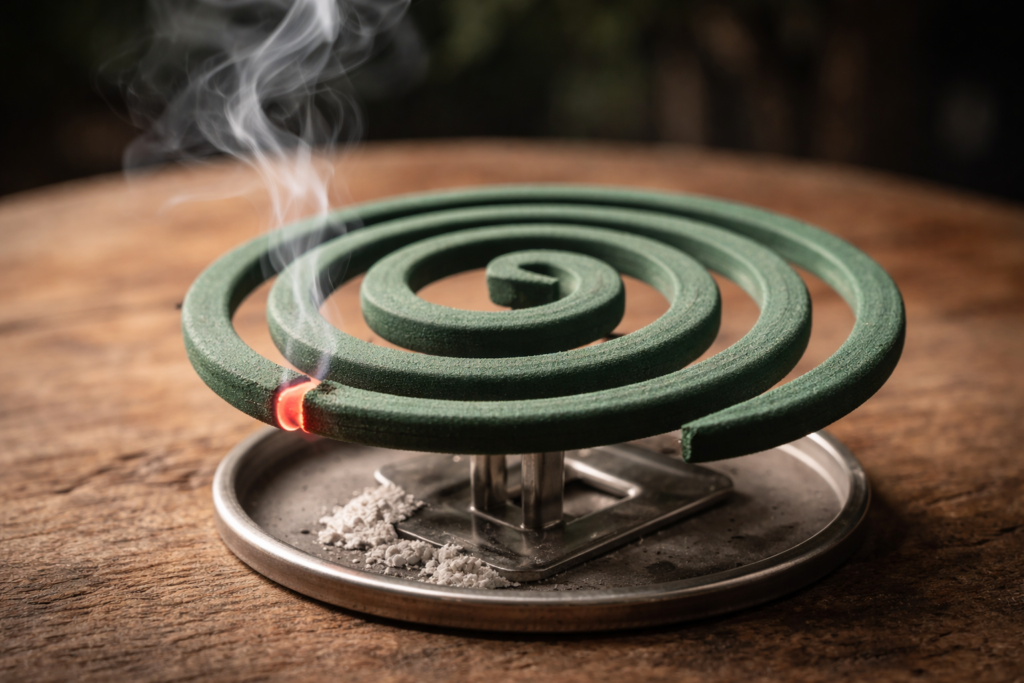
Mosquito coils work by slowly burning and releasing insecticidal smoke, usually containing pyrethroids such as allethrin or transfluthrin. While these chemicals are effective against mosquitoes, the combustion process produces a complex mixture of pollutants.
Key components released when a mosquito coil burns
- Fine particulate matter (PM2.5)
- Carbon monoxide (CO)
- Volatile organic compounds (VOCs) such as benzene and formaldehyde
- Polycyclic aromatic hydrocarbons (PAHs)
- Pyrethroid insecticides
Studies have shown that burning a single mosquito coil can release particulate matter equivalent to dozens of cigarettes in a closed room, significantly degrading indoor air quality (Liu et al., 2003).
The Centers for Disease Control and Prevention warns that fine particles (PM2.5) can penetrate deep into the lungs and even enter the bloodstream, increasing the risk of respiratory and cardiovascular problems.
Children face a disproportionately higher risk from indoor air pollutants due to several biological and behavioral factors.
1. Developing lungs and immune systems
Children’s lungs continue to grow and mature throughout childhood and adolescence. Exposure to irritants during this critical period can permanently affect lung development and function.
2. Higher breathing rate
Children breathe faster than adults, meaning they inhale more polluted air per unit of body weight, increasing toxin exposure.
3. Immature detoxification mechanisms
The liver and kidneys of young children are not fully developed, reducing their ability to detoxify harmful chemicals.
4. Proximity to the source
Children often sleep closer to the ground, where heavier pollutants from smoke tend to settle.
According to the National Institutes of Health, early-life exposure to indoor air pollution is strongly linked to chronic respiratory disease later in life.
[Also read: What Are the Early Warning Symptoms of Milk Adulteration Exposure That Americans Should Not Ignore]
Short-Term Health Effects
1. Coughing and airway irritation
One of the earliest and most common symptoms is persistent coughing. Mosquito coil smoke irritates the lining of the airways, leading to:
- Dry or productive cough
- Throat irritation
- Chest discomfort
These symptoms are often worse at night when coils are burned in closed bedrooms.
2. Wheezing and asthma exacerbation
For children with asthma, mosquito coil smoke can be particularly dangerous. Studies show that exposure can:
- Trigger asthma attacks
- Increase wheezing and breathlessness
- Increase the need for rescue inhalers
The CDC identifies indoor smoke as a major asthma trigger, especially in children.
3. Eye, nose, and throat irritation
Parents may notice:
- Red, watery, or itchy eyes
- Runny or blocked nose
- Sneezing and sore throat
These symptoms result from chemical irritation caused by pyrethroids and combustion by-products.
4. Headache, dizziness, and nausea
In poorly ventilated rooms, mosquito coil smoke can cause neurological symptoms, including:
- Headache
- Dizziness or lightheadedness
- Nausea or vomiting
Carbon monoxide and VOCs are likely contributors to these effects.
Long-Term Health Effects
1. Impaired lung growth and reduced lung function
Chronic exposure to indoor air pollution during childhood has been associated with:
- Reduced lung capacity
- Delayed lung development
- Increased risk of chronic obstructive airway diseases later in life
The WHO links long-term indoor smoke exposure to reduced lung function and increased respiratory morbidity in children.
2. Increased risk of recurrent respiratory infections
Repeated irritation of the airways weakens natural defense mechanisms, increasing susceptibility to:
- Bronchitis
- Pneumonia
- Frequent chest infections
Children exposed to indoor smoke often experience longer and more severe respiratory illnesses
3. Neurodevelopmental effects
Although research is ongoing, some studies suggest that chronic exposure to insecticides and indoor air pollutants may affect:
- Cognitive development
- Attention and behavior
- Learning outcomes
Pyrethroids are neurotoxic to insects, and while considered safer for humans at low doses, chronic inhalation exposure in children raises concern.
4. Increased allergy sensitization
Indoor pollutants can alter immune responses, potentially increasing the risk of:
- Allergic rhinitis
- Eczema
- Environmental allergies
Children with a family history of allergies may be especially vulnerable.
Mosquito Coil Smoke and Infants
Infants are at the highest risk because:
- Their lungs are extremely immature
- They spend most of their time indoors
- They cannot communicate symptoms clearly
Exposure in infancy has been associated with:
- Increased lower respiratory tract infections
- Poor weight gain due to repeated illness
- Hospital admissions for breathing difficulties
Pediatric health experts strongly advise never burning mosquito coils in rooms where infants sleep.
Indoor Air Pollution
Mosquito coil smoke is often underestimated compared to cigarette smoke or cooking fumes. However, research suggests it can be equally harmful in enclosed spaces.
Comparative findings:
- One mosquito coil can emit PM2.5 levels similar to 20–100 cigarettes (Liu et al., 2003)
- Night-long exposure can exceed safe indoor air quality limits
- Effects are amplified in small, poorly ventilated rooms
The WHO emphasizes that there is no safe level of indoor air pollution for children.
Warning Signs
Seek medical advice if a child exposed to mosquito coil smoke develops:
- Persistent cough lasting more than a few days
- Wheezing or difficulty breathing
- Recurrent chest infections
- Poor sleep due to coughing or breathlessness
- Headache, dizziness, or unexplained nausea
Early recognition can prevent long-term damage.
Safer Alternatives
Parents do not need to choose between mosquito bites and toxic smoke. Safer options include:
1. Mosquito bed nets
Highly effective, especially for infants and young children.
2. Window and door screens
Physical barriers reduce mosquito entry without chemicals.
3. Electric vaporizers
Preferably with good ventilation and away from sleeping areas.
4. Environmental control
- Remove stagnant water
- Use fans to reduce mosquito activity
5. Protective clothing and repellents
Age-appropriate repellents used according to guidelines can be safer than smoke exposure.
If alternatives are unavailable:
- Never burn coils in closed rooms
- Keep them far from children
- Ensure cross-ventilation
- Avoid overnight use in bedrooms
Even these measures do not eliminate risk, but may reduce exposure.
Conclusion
Mosquito coils are widely used, inexpensive, and familiar—but their smoke is far from harmless, especially for children. Scientific evidence shows that mosquito coil smoke releases fine particulate matter, toxic gases, and insecticides that can irritate airways, worsen asthma, increase respiratory infections, and potentially impair lung and neurodevelopment with repeated exposure. Children, infants, and those with asthma or allergies are particularly vulnerable.
Protecting children does not mean ignoring mosquito risks; it means choosing safer, evidence-based alternatives such as bed nets, screens, and environmental control. Where coils are unavoidable, strict ventilation and limited use are essential. From a public health perspective, reducing indoor air pollution remains one of the most effective ways to safeguard children’s long-term health. Awareness today can prevent chronic illness tomorrow.
[Also read: Why Are Skin Irritation and Itching More Common in Americans Exposed to Urban Dust From Roads and Pavements?]
This article is for informational purpose only and does not substitute for professional medical advise. For proper diagnosis and treatment seek the help of your healthcare provider.
References:
- World Health Organization. (2023). Household air
pollution and health.
- World Health Organization. (2022). Air quality
guidelines: Global update.
- Centers for Disease Control and Prevention. (2024). Indoor
air quality and health.
- Centers for Disease Control and Prevention. (2023). Asthma
triggers.
- National Institutes of Health. (2022). Children’s
environmental health.
- Liu, W. K., Zhang, J., & Hashim, J. H. (2003).
Mosquito coil emissions and health implications. Indoor Air, 13(4),
343–352.
- Zhang, J., Smith, K. R., et al. (2000). Indoor air
pollution from household fuel combustion. Environmental Health
Perspectives, 108(9), 859–866.
- Chen, S. C., et al. (2008). Exposure to mosquito coil
smoke and respiratory health. Journal of Exposure Science &
Environmental Epidemiology, 18(3), 292–300.
- Pope, C. A., & Dockery, D. W. (2006). Health
effects of fine particulate air pollution. Journal of the Air &
Waste Management Association, 56(6), 709–742.
- American Academy of Pediatrics. (2021). Environmental
health risks to children.
- Bruce, N., Perez-Padilla, R., & Albalak, R. (2000).
Indoor air pollution in developing countries. Bulletin of the WHO,
78(9), 1078–1092.
- WHO & UNICEF. (2020). Protecting children from
air pollution.
- National Institute of Environmental Health Sciences.
(2022). Pyrethroids and human health.
- Balmes, J. R. (2019). Household air pollution and
respiratory disease. New England Journal of Medicine, 381, 203–204.
- U.S. Environmental Protection Agency. (2023). Particulate
matter (PM2.5) and health.
- Jaakkola, J. J. K., & Knight, T. L. (2008). The
role of exposure to indoor air pollution in childhood asthma. European
Respiratory Journal, 31(4), 759–769.
- Smith, K. R., et al. (2014). Millions dead: How do we
know and what does it mean? Methods used in global estimates of
household air pollution.
- World Health Organization. (2018). WHO guidelines
for indoor air quality: Selected pollutants.