
Skin Problems in Americans Due to Changing UV Levels.
Dr JK Avhad MBBS MD [Last updated 28.12.2025]
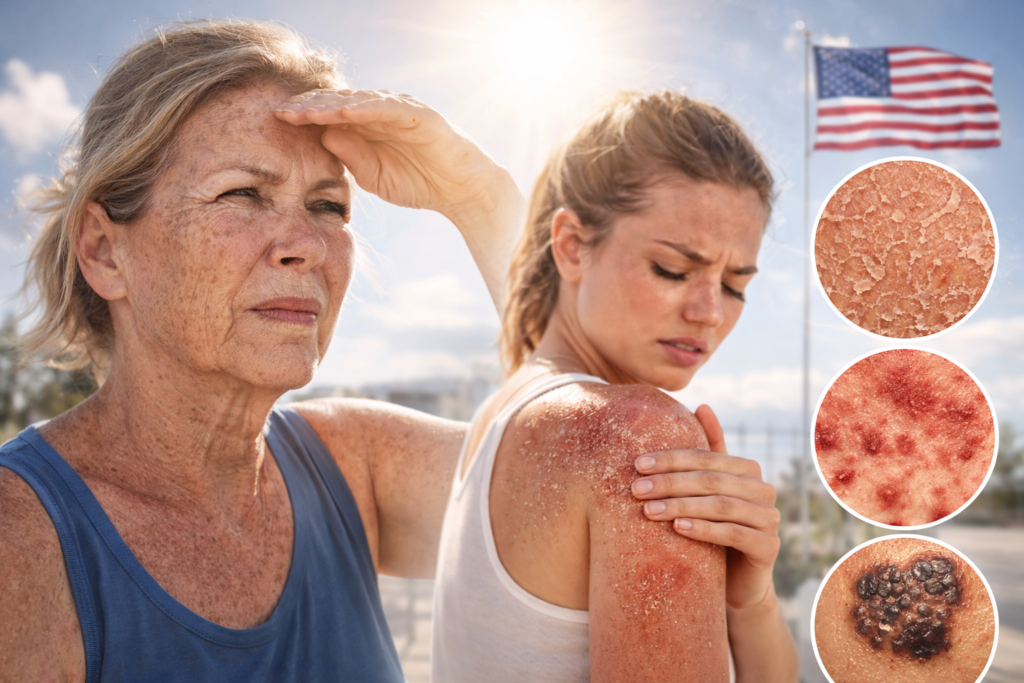
Rising UV levels in the USA are causing more sunburn, rashes, pigmentation, and early aging. Learn why UV is increasing, what skin problems Americans face, and how to protect your skin from stronger sunlight.
Over the last decade, many Americans have noticed something unusual: the sun feels stronger than before, even during short outdoor exposure. Dermatologists across the United States report an increase in sunburn cases, skin sensitivity, hyperpigmentation, sun allergies, and premature aging, even in states that historically had moderate ultraviolet (UV) levels. This growing trend aligns with scientific observations showing changing UV radiation patterns in the USA due to climate change, ozone fluctuations, and atmospheric shifts (EPA, 2024).
The rise in UV exposure affects every demographic—from children to outdoor workers—and contributes to a wide range of skin disorders that were previously less common. This article breaks down why UV levels are rising, what skin problems they cause, who is most at risk, and how Americans can protect their skin.
Ultraviolet (UV) radiation is a form of energy emitted by the sun. The United States uses the UV Index (UVI)—developed by the EPA and NOAA—to measure the strength of UV radiation at any given time. Higher values indicate greater risk of skin damage.
UV Types:
- UVA: Penetrates deeply, causes premature aging
- UVB: Causes sunburn and DNA damage
- UVC: Absorbed by atmosphere, doesn’t reach humans
Even small increases in UVB levels lead to significant increases in DNA damage and skin-cancer risk (CDC, 2023).
In recent years, many U.S. regions have reported unusually high summer UVI readings. States like California, Nevada, Florida, Texas, New Mexico, Colorado, and Arizona regularly see UVI levels of 9–12, indicating extreme exposure risk (NOAA, 2024).
Why Are UV Levels Changing?
Climate change affects UV levels in several interconnected ways. While temperature rises are widely discussed, changes in cloud cover, ozone distribution, humidity, aerosols, and reflective surfaces also modify how much UV reaches American skin.
Below are the key scientific reasons:
Ozone Layer Variability
The ozone layer blocks harmful UVB radiation. Although long-term ozone recovery is underway, seasonal thinning and regional ozone depletion still occur, allowing more UV radiation to reach the ground (NASA, 2024).
This results in:
- Higher UVB exposure
- Faster sunburn
- Increased DNA-damaging radiation
Changing Cloud Patterns
Climate change affects cloud thickness and cloud cover frequency. Many western and southern U.S. states now experience more cloud-free days, allowing deeper UV penetration (NOAA, 2024).
Cloud thinning alone can increase UV exposure by 20–40%.
Increased Heat and Heat waves
Higher temperatures correlate with:
- Stronger ground-reflection of UV
- Longer outdoor stays in sunlight
- Higher skin inflammation responses
Heat also reduces the skin’s natural resilience, increasing sunburn susceptibility.
Reduced Air Pollution and Aerosols
Cleaner air is beneficial for respiratory health, but fewer aerosols mean less UV scattering—resulting in stronger UV reaching the ground (EPA, 2024).
Changes in Snow, Sand, and Water Reflectivity
UV reflectivity increases with:
- Melting snow
- Drier soil
- More extreme drought areas
- Coastal erosion
These surfaces bounce UV back onto the skin, increasing exposure.
UV Levels Affecting the Skin
Below are the most common skin problems linked to the rising UV intensity across the United States—each reinforced by emerging dermatological reports.
Sunburn From Minimal Sun Exposure
Sunburn is the most immediate form of UV damage. Rising UVB levels now cause visible burns in as little as 10–20 minutes, especially during heat waves.
Symptoms:
- Redness
- Warm or burning sensation
- Blistering (severe cases)
- Peeling after 2–3 days
Americans in northern states (Michigan, New York, Washington, Pennsylvania) report more frequent sunburns than a decade ago.
Hyperpigmentation & UV-Induced Dark Spots
UV radiation stimulates melanocytes, producing melanin. Climate-driven UV changes have increased:
- Age spots
- Freckles
- Melasma flare-ups
- Uneven skin tone
Hyperpigmentation is especially worsening among:
- Hispanic Americans
- African Americans
- Asian Americans
- Light-brown and olive skin tones
Modern dermatology considers UV exposure the most important trigger for pigmentation disorders (AAD, 2024).
Polymorphic Light Eruption-PMLE (Sun Allergy)
PMLE is becoming significantly more common, particularly in young adults and women.
Symptoms:
- Itchy bumps
- Red rash
- Skin swelling
- Occurs hours to days after sun exposure
Climate change increases PMLE episodes because:
- UV levels fluctuate unpredictably
- Sudden UV intensity shocks the immune system
Premature Aging (Photoaging)
UVA rays penetrate the dermis and damage collagen. Rising UV exposure accelerates:
- Fine lines and wrinkles
- Crepey skin
- Rough texture
- Enlarged pores
- Sagging skin
The American Academy of Dermatology notes a measurable increase in UV-induced premature aging among Americans under 35 (AAD, 2024).
Heat Rashes and Sun-Induced Dermatitis
High heat and high UV intensifies skin inflammation.
Common issues include:
- Prickly heat
- Eczema flare-ups
- Hives triggered by UV radiation
- Rosacea worsening
People with sensitive skin experience more prolonged symptoms.
Skin Barrier Damage
UV radiation weakens the skin barrier by:
- Dehydrating the epidermis
- Damaging keratinocytes
- Increasing transepidermal water loss (TEWL)
Increased Risk of Skin Cancer
Melanoma and non-melanoma skin cancers are strongly linked to UV exposure. According to CDC, melanoma incidence has risen across the USA in the last 20 years (CDC, 2023).
Rising UVB levels is increasing cancer risks.
WHO Is Most at Risk?
High-risk groups:
- Fair-skinned Americans (Fitzpatrick I–II)
- Outdoor workers (construction, agriculture, delivery)
- Children and teens
- Elderly citizens
- People taking photosensitizing medications
- Americans in high-altitude states (Colorado, Utah)
- Coastal populations
- Frequent beachgoers
Dark-skinned Americans also experience increased pigmentation, melasma, and vitamin D imbalance due to shifting UV exposure.
How to Protect Your Skin ?
Use Broad-Spectrum Sunscreen Daily (SPF 50 or higher)
Key steps:
- Apply 15 minutes before sun exposure
- Reapply every 2 hours
- Use water-resistant formulas for outdoor activities
Mineral sunscreens (zinc oxide, titanium dioxide) offer better UVB and UVA protection.
Wear UPF Protective Clothing
UPF 30–50+ clothing blocks significant radiation and remains effective throughout the day.
Check the UV Index Daily
Many Americans ignore the UV Index, even when it reaches extreme levels.
Apps such as:
- EPA SunWise
- AccuWeather
- UVLens
provide real-time alerts.
Avoid Peak Sun Hours (10 AM – 4 PM)
UV levels in this window are highest—even in cloudy weather.
Use Antioxidants (Vitamin C, Vitamin E)
They help neutralize free radicals caused by UV exposure and reduce pigmentation.
Moisturize Frequently
UV radiation disrupts the skin barrier; hydration is essential for repair.
Monitor Moles and Skin Changes
Use the ABCDE rule for melanoma:
- Asymmetry
- Border irregularity
- Color changes
- Diameter > 6 mm
- Evolving appearance
Seek medical evaluation for any suspicious change.
FAQs
Q. Are UV levels really rising in the USA?
Yes. EPA and NOAA confirm seasonal UV increases, especially during heat waves and ozone variability (EPA, 2024).
Q. Why does the sun feel hotter now?
More UV intensity, more heat waves cause stronger skin reactions.
Q. Does climate change directly cause skin problems?
Indirectly yes. It influences UV exposure, temperature, humidity, and air quality.
Q. Can darker skin tones be affected by changing UV?
Yes—they develop more pigmentation, melasma, and uneven skin tone.
Q. Is sunscreen enough to protect me?
Sunscreen helps, but clothing, timing, shade offer stronger protection.
Q. Can UV exposure harm children more than adults?
Yes. Children’s skin is thinner and accumulates long-term UV damage faster.
Q. Does UV cause vitamin D deficiency or excess?
Changing UV patterns can disrupt natural vitamin D balance, especially in northern states.
Conclusion
Changing UV levels in the United States are creating new challenges for skin health. From sunburn and pigmentation to sun allergies and premature aging, millions of Americans are feeling the impact of stronger and more unpredictable UV radiation. Climate change accelerates these shifts, making sun protection more essential than ever.
Americans of all skin tones must adapt to rising UV exposure with better skincare routines, protective clothing, and consistent sun protection practices. Understanding the link between climate change and skin health is the first step toward prevention.
This article is for informational purpose only and does not substitute for professional medical advise. For proper diagnosis and treatment seek the help of your healthcare provider.
References:
- Environmental Protection Agency (EPA). Climate Change Indicators: UV Radiation in the USA (2024).
- National Oceanic and Atmospheric Administration (NOAA). Atmospheric Ozone and UV Index Trends (2023–2024).
- Centers for Disease Control and Prevention (CDC). Melanoma and Skin Cancer Statistics in the United States (2023).
- NASA Atmospheric Science Division. Changes in Aerosols and UV Transmission (2024).
- American Academy of Dermatology (AAD). UV Exposure, Photoaging, and Skin Health (2024).
- Harvard Health Publishing. Sun Exposure and Skin Health in a Changing Climate (2023).