
Why Are Skin Irritation and Itching More Common in Americans Exposed to Urban Dust From Roads and Pavements?

Dr JK Avhad MBBS MD [Last updated 03.01.2026]
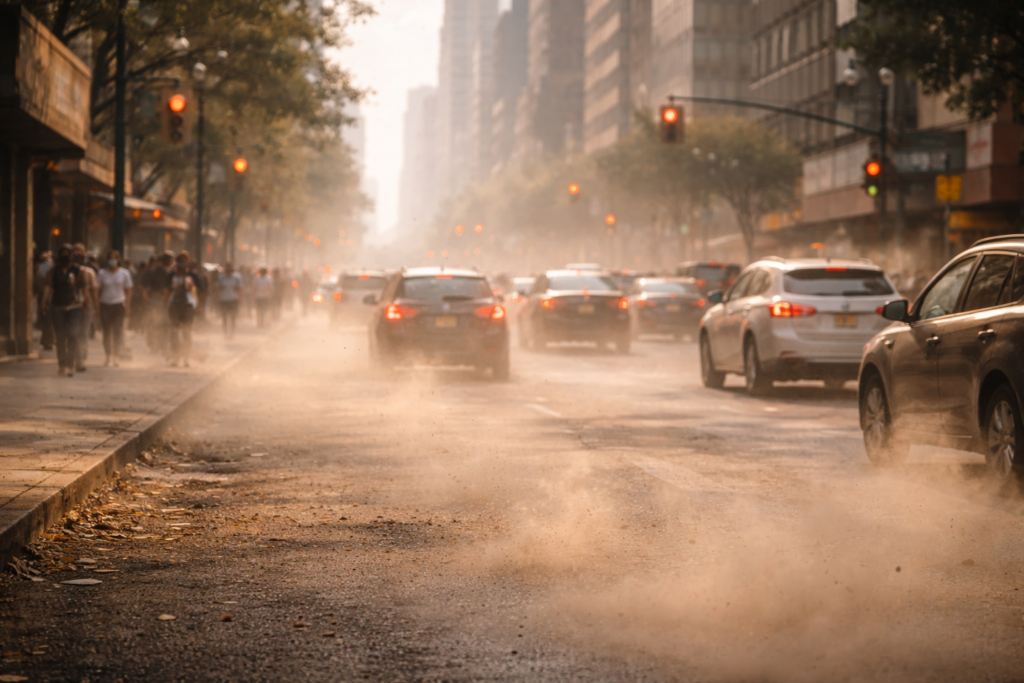
Road and pavement dust is easy to ignore because it looks “normal”—a gritty film on windowsills, a haze near traffic lights, a brown layer that returns days after cleaning. But for many Americans living in busy cities, that dust isn’t just dirt. It’s a mix of soil particles, tire and brake wear, diesel soot, construction debris, salts, and metals that can irritate the skin directly and also worsen inflammation through the airways and immune system. “Dust from roads” is a common source of PM10 particle pollution and that particle pollution can irritate the eyes, nose, and throat. While the strongest evidence for road dust harms is respiratory and cardiovascular, research increasingly links particulate pollution with skin barrier disruption, eczema/atopic dermatitis flares, and itching. In peak dust seasons—dry weather, construction booms, high-traffic summers—urban Americans may experience more itching, rashes, and “mystery irritation” that improves when exposure drops.
Urban road dust is the fine material that builds up on streets and gets re-suspended into the air by traffic, wind, and construction. Unlike “clean soil,” road dust often contains a complex mixture of:
- Crushed pavement and mineral particles
- Tire wear and brake wear particles
- Diesel and gasoline combustion residue (soot and organic compounds)
- Construction dust (cement, silica-containing material)
- Metals (e.g., iron, copper, zinc, lead in some contexts)
- Road salt residues in colder U.S. regions
A peer-reviewed literature review describes road dust as a complex mixture with components that can be associated with multiple health effects, emphasizing that composition varies by location and source (traffic, industry, construction). (PMC)
Itching (pruritus) and irritation are common symptoms across many conditions (eczema, allergies, dry skin, contact dermatitis). What’s changed in many U.S. cities is the trigger load:
- More traffic congestion
- More construction activity
- Hotter, drier periods that increase dust and reduce humidity (dry skin)
- More time indoors with particle accumulation and recirculation
Particle pollution includes larger particles (PM10) from sources including dust from roads and that PM10 can irritate mucous membranes. Skin is also a barrier organ exposed directly to these particles.
Mechanisms:
1) Mechanical irritation and micro-abrasion
Fine gritty particles can act like sandpaper at a microscopic level, especially on:
- Eyelids
- Neck
- Forearms
- Ankles and lower legs
- Areas under clothing friction
If the skin barrier is already dry or inflamed, this “physical abrasion” can trigger itch faster.
2) Chemical irritation from mixed pollutants
Road dust can carry irritants such as:
- Polycyclic aromatic hydrocarbons (combustion byproducts)
- Metals
- Salts
- Industrial residues (location dependent)
These can disrupt skin surface lipids and trigger irritation.
3) Contact dermatitis pathways
Some people develop irritant contact dermatitis (non-allergic) from repeated exposure, and others may develop allergic contact dermatitis if sensitized to specific components.
Particulate matter and itching:
A major mechanistic theme in dermatology is skin barrier dysfunction. When the barrier is compromised, you get:
- Higher transepidermal water loss (dryness)
- Easier penetration of irritants/allergens
- More inflammation and itching
A review focused on particulate matter and skin barrier dysfunction explains that PM exposure can compromise the barrier and may contribute to development or exacerbation of allergic diseases such as atopic dermatitis. (PMC)
A systematic review/meta-analysis found particulate matter is closely associated with atopic dermatitis, eczema, and skin allergies. (PMC)
Air pollution as a culprit
Air pollution has been linked in multiple reviews to exacerbation of inflammatory skin conditions (atopic dermatitis, psoriasis, acne, etc.).
A clinical study examining atopic dermatitis symptoms reported associations between air pollutants and exacerbation of itching and sleep disturbance among AD patients.
High-traffic roads:
High-traffic areas create continuous dust re-suspension:
- Cars and trucks kick particles up repeatedly
- Brake and tire wear add fresh particles
- Congestion increases localized pollution
Dry weather and low humidity
Low humidity:
- Dries the skin
- Increases cracking and barrier weakness
- Makes itch thresholds lower
Combine that with dust exposure and you can see more dermatitis-like symptoms.
Indoor exposure
Road dust doesn’t stay outside. It enters the home via:
- Shoes
- Clothing hems
- Pet paws and fur
- Open windows
- HVAC intake (depending on filtration)
Once inside, particles settle into:
- Carpets
- Bedding
- Couches
- Curtains
Then they re-aerosolize when people move around.
[Also read: How Does Indoor Pollen Accumulation Worsen Allergy Symptoms in American Homes During Peak Seasons?]
[Click here: https://healthconcise.com/how-does-indoor-pollen-accumulation-worsen-allergy-symptoms-in-american-homes-during-peak-seasons/]
Why children, older adults, and people with eczema feel it more
People with:
- Atopic dermatitis/eczema
- Sensitive skin
- Asthma/allergic rhinitis
- Older, thinner skin barriers
…often have stronger symptom responses to particle exposures.
Reviews emphasize air pollution’s role in worsening atopic dermatitis and discuss mechanistic pathways like oxidative stress and barrier impairment.
Common symptom
- Itching after commuting or time near busy intersections
- Facial itching, eyelid irritation, or neck rash
- Forearm irritation after outdoor walks
- “Mystery itch” that improves on rainy days (less dust re-suspension)
- Flares of eczema on high-AQI days
- Scratch marks and sleep disruption during dry/dusty weeks
How to reduce skin contact with dust outdoors
- Wear sunglasses to reduce eye-area deposition
- Use a light physical barrier (long sleeves) on high-dust days
- Rinse face and hands after returning indoors
- Shower after long outdoor exposure during dusty weeks
How to reduce indoor dust exposure
Shoes-off entry routine
Road dust travels on shoes. A shoes-off policy and entry mat lowers tracked-in particles.
Damp dusting and wet mopping
Dry dusting can re-suspend particles; damp wiping captures them.
HEPA matters
A vacuum without good filtration can blow fine particles back into the air. A sealed HEPA vacuum is better for fine particulate removal.
Indoor air filtration
- Upgrade HVAC filters to higher-efficiency options your system can handle
- Use a portable HEPA purifier, especially in the bedroom
- Keep windows closed during peak traffic hours if you live next to major roads
Particle pollution can be harmful and that dust from roads is a PM10 source. (CDC)
Particulate matter includes fine particles that can be inhaled and pose health risks. (EPA)
Protect the skin barrier
This is the “dermatology side” that makes environmental control work better:
- Use fragrance-free moisturizers (barrier support)
- Apply moisturizer after showering (seal in hydration)
- Use gentle cleansers (avoid stripping oils)
- Avoid over-hot showers during dry seasons
Seek medical evaluation if you have:
- Widespread rash with fever
- Blistering, oozing, or signs of infection
- Persistent itching without rash that lasts weeks (can be systemic causes)
- New hives or swelling (allergic reaction)
- Significant sleep loss
[Also read: How Does Climate Change–Related Increase in Pollen Seasons Worsen Asthma Control in Urban American Children?]
FAQs
1) Can road dust really cause skin itching, or is it mostly a lung problem?
Road dust is widely studied for respiratory/cardiovascular effects, but particulate pollution also affects skin barrier and inflammatory skin diseases. Reviews and meta-analyses link PM exposure with eczema/atopic dermatitis and skin barrier dysfunction, which can increase itching.
2) Why is my itching worse on dry, windy days?
Dry air weakens the skin barrier and wind increases dust re-suspension. Dust deposits on already-dry skin, making irritation and itching more likely.
3) Why do symptoms improve after rain?
Rain suppresses dust re-suspension and temporarily lowers airborne particle load.
4) What’s the fastest home change that helps most people?
A “clean-air bedroom”: HEPA purifier in the bedroom, shoes-off policy, damp cleaning, and consistent moisturizing.
5) Is itching without a rash still related to dust?
It can be—especially if the skin is dry and irritated. But persistent itch without rash should be evaluated because other causes exist.
6) Do masks help skin symptoms?
Masks primarily reduce inhalation exposure, but they can also reduce facial particle deposition for some people. Skin friction from masks can worsen irritation in others—so it’s individual.
7) What if I already have eczema?
People with eczema often have a weaker barrier and may flare more with particulate pollution. Reviews discuss pollution-associated exacerbations of atopic dermatitis.
8) What do major public health agencies say about road dust?
CDC lists road dust as a PM10 source and notes PM10 can irritate eyes, nose, and throat; fine PM can pose deeper health risks. WHO also recognizes air pollution as a major health risk globally and discusses broad health impacts including on skin in its publications and summaries.
Conclusion
Urban road and pavement dust is more than a nuisance layer on cars—it’s a complex mixture of particles from traffic, brake and tire wear, construction, and local soil that can deposit on skin, weaken the skin barrier, and amplify inflammation. The CDC identifies road dust as a common source of PM10 particle pollution, and modern dermatology research increasingly connects particulate exposure to skin barrier dysfunction, eczema flares, and itching. That is why Americans living near busy roads, intersections, and construction corridors often report more itching and irritation—especially during dry, windy periods when dust re-suspends. The most effective approach is a realistic “three-part plan”: reduce entry (shoes-off and rinse routines), remove reservoirs (damp cleaning + HEPA vacuum), and protect the barrier (consistent moisturizing and gentle cleansing). As cities grow and traffic stays dense, treating road dust as a skin-health trigger—like pollen or harsh soap—can help reduce flares and improve sleep.
[Also read: Why Are Anxiety and Stress Symptoms Higher in Americans Living in Environmentally Degraded Urban Areas?]
This article is for informational purpose only and does not substitute for professional medical advise. For proper diagnosis and treatment seek the help of your healthcare provider.
References:
- Centers for Disease Control and Prevention. (2024). Air
Pollutants | Air Quality. CDC
- U.S. Environmental Protection Agency. (2025). Particulate
Matter (PM) Basics. EPA
- Khan, R. K., Strand, M. A., & others. (2018). Road
dust and its effect on human health: A literature review. Environmental
Research and Public Health (PMC). PMC
- Kim, B. E., et al. (2021). Particulate matter causes
skin barrier dysfunction. Journal/PMC review. PMC
- Park, D., et al. (2017). Systematic review and
meta-analysis of human skin diseases associated with particulate matter. International
Journal of Environmental Research and Public Health (PMC). PMC
- Lai, A., et al. (2023). The impact of air pollution on
atopic dermatitis. Review (PMC). PMC
- Nakhjirgan, P., et al. (2019). Air pollution and
exacerbation of skin itching and sleep disturbance in atopic dermatitis. Study
(PMC). PMC
- Gu, X., et al. (2024). Air pollution and skin diseases:
Comprehensive mechanisms and evidence. Ecotoxicology and Environmental
Safety (ScienceDirect). ScienceDirect
- Roberts, W. (2021). Air pollution and skin disorders. Clinical
Dermatology review (ScienceDirect). ScienceDirect
- Paik, K., et al. (2024). Particulate matter and its
molecular effects on skin. International Journal of Molecular Sciences.
MDPI
- Han, H. S., et al. (2024). Air pollution and skin
diseases. Annals of Dermatology. anndermatol.org
- Han, H. S., et al. (2025). Air Pollution and Skin
Diseases. Review (PMC). PMC
- Liu, C. X., et al. (2025). The role of air pollution in
the pathogenesis of atopic dermatitis. Review (PMC). PMC
- Lee, Y.-L., Su, H.-J., Sheu, H.-M., Yu, H.-S., &
Guo, Y. L. (2008). Traffic-related air pollution and prevalence of eczema
in school children. Journal of Investigative Dermatology. ScienceDirect
- Puri, P., & Nandar, S. K. (2017). Effects of air
pollution on the skin: A review. Indian Journal of Dermatology,
Venereology and Leprology. Indian J Dermatology
- World Health Organization. (n.d.). Air pollution
(Health topic). anndermatol.org
- World Health Organization. (n.d.). Air pollution and
health impacts overview. PMC
- National Library of Medicine. (n.d.). General
background on dermatitis and skin barrier concepts (NCBI/PMC resources).
PMC+1
- Centers for Disease Control and Prevention. (2025). Air
quality guidance and health effects of PM (additional CDC context). CDC
- Jackson, C. M., et al. (2023). Impact of air pollution
on atopic disease pathways (skin barrier discussion). Study/summary
(EuropePMC). Europe PMC