
Long-Term Exposure to Traffic Air Pollution Increase Fatigue and Brain Fog in Urban Adults
Dr JK Avhad MBBS MD [Last updated 24.12.2025]
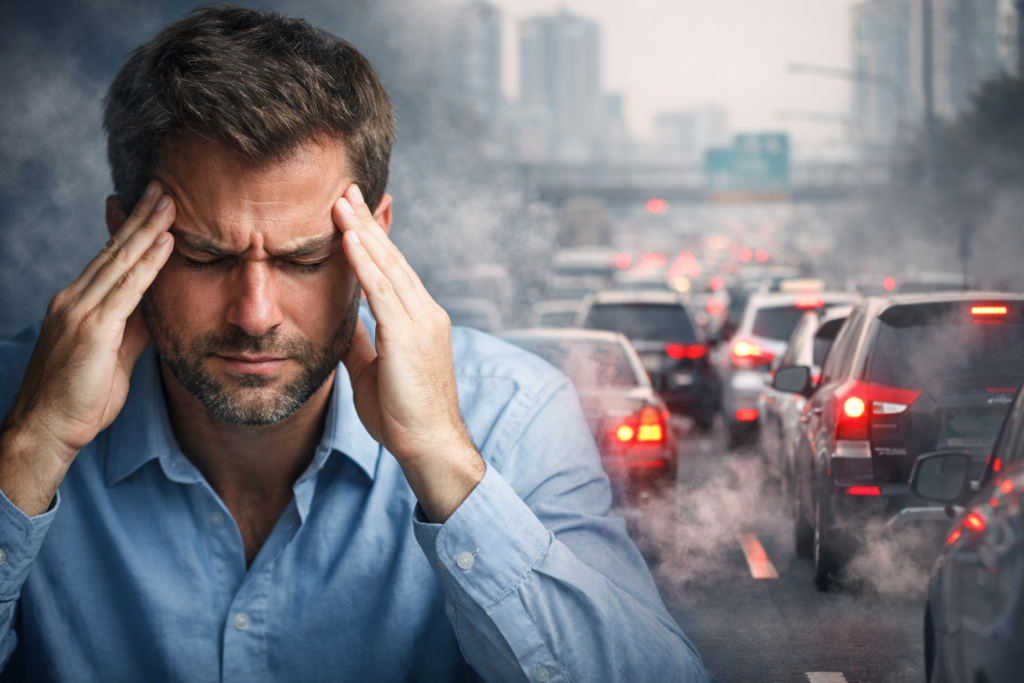
Long-term exposure to traffic air pollution is more than a lung issue—it can show up as everyday exhaustion, “brain fog,” slowed thinking, headaches, and low motivation, especially for urban American adults living or working near busy roads.
Traffic pollution is not just “smog.” It’s a complex mix of gases and particles created by tailpipes, brake and tire wear, road dust, and the way air moves through streets and highways. Over time, breathing this mix can affect the whole body—lungs, heart, blood vessels, and the brain.
If you live in a U.S. city, you’ve probably felt it: the day you wake up tired, caffeine doesn’t help much, your head feels “cottony,” and even simple tasks take extra effort. People often blame age, stress, screens, or sleep. Sometimes those are the culprits. But there’s another factor that’s easy to miss because it’s so common: chronic exposure to traffic air pollution.
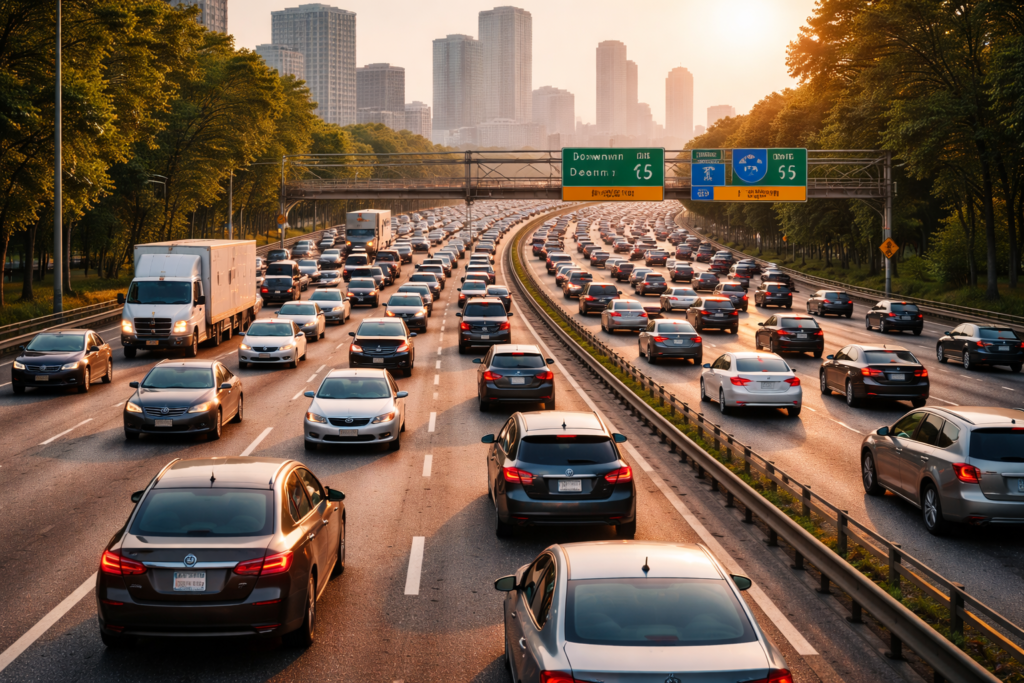
Traffic-related air pollution usually includes:
- PM2.5 (fine particulate matter): particles ≤2.5 microns that can reach deep into the lungs and enter circulation.
- Ultrafine particles (UFPs): even smaller particles (<0.1 micron). These are abundant near busy roads and can spike quickly with traffic flow.
- Black carbon (soot): a marker of diesel and “fresh” combustion emissions.
- Nitrogen dioxide (NO₂): a gas strongly linked with vehicle emissions and near-road exposure.
- Ozone (O₃): not emitted directly by cars, but formed when sunlight reacts with pollution—often worse on hot days.
Fatigue is not just “being sleepy.” It’s reduced capacity—physical, mental, and emotional. With traffic pollution, fatigue can build through several overlapping pathways:
Fine particles (PM2.5) and combustion-related pollutants can trigger systemic inflammation—not only in the lungs, but throughout the body. Inflammation changes how you regulate energy, sleep quality, and stress hormones. You may feel “wired and tired,” or exhausted despite adequate time in bed.
Traffic pollution contains reactive chemicals and metal-rich particles that increase oxidative stress—an imbalance between free radicals and your body’s defenses. Oxidative stress can interfere with mitochondrial function, the “power plants” in cells. When cellular energy production becomes less efficient, fatigue becomes more likely.
Even subtle changes in lung function or blood vessel tone can reduce oxygen delivery efficiency. You don’t need obvious shortness of breath to feel drained—sometimes it presents as reduced exercise tolerance, heavier legs, or “I get tired too easily now.”
EPA summarizes strong evidence that particle pollution can exacerbate cardiovascular disease and trigger events in susceptible people—showing how the heart and vessels are part of the pollution story. (EPA)
Brain fog isn’t a medical diagnosis. It’s a cluster: slower thinking, trouble focusing, forgetfulness, feeling mentally “hazy,” reduced word-finding, irritability, and low motivation.
Your brain needs steady blood flow. Pollution-related inflammation can impair vascular function and promote microvascular stress. The brain may not get the same smooth delivery of oxygen and nutrients, especially during stress or poor sleep.
Studies reviewing air pollution and cognition describe consistent links between particulate matter exposure and poorer cognitive performance, with mechanisms involving neuroinflammation and potential impacts on neurodegenerative pathways. (PMC)
Near busy roads, people inhale more fresh combustion particles, black carbon, and ultrafine particles. These can spike quickly during rush hour. Research on near-road indicators like black carbon and UFPs shows measurable changes with traffic patterns and interventions (like reduced traffic). (PMC)
The World Health Organization updated its global air quality guidelines in 2021, recommending an annual PM2.5 guideline of 5 µg/m³ (much stricter than many places achieve). (World Health Organization)
A CDC analysis of proximity to highways found roughly 4% of the U.S. population lived within 150 meters of a major highway (a distance associated with higher exposure). (CDC)
EPA communications about near-road pollution note tens of millions of Americans live very close to major transportation facilities, underscoring how common near-road exposure is. (EPA
Peer-reviewed research has linked exposure to particulate air pollution with cognitive function measures and cognitive decline over time. (PMC)
At the same time, newer research methods sometimes debate causality versus association, so it’s best to describe the evidence honestly: strong and growing, but complex, with confounders (noise, stress, socioeconomic factors, heat, sleep). (Aerosol and Air Quality Research)

If traffic pollution is contributing, patterns often appear:
- Morning and evening commute exposure
- Idling traffic and stop-and-go driving
- Bus depots, delivery corridors, freeway ramps
Heat and sunlight can increase ozone formation and intensify pollution episodes. Hot days can also increase dehydration and sleep disruption—multiplying fatigue pathways.
Even if wildfire smoke isn’t “traffic,” it adds PM2.5 on top of your usual exposures, which can amplify symptoms. Your city might have “normal” traffic pollution and a smoke layer that makes it much harder to recover.
Traffic pollution doesn’t hit everyone equally. Higher risk groups include:
- Adults with asthma/COPD, heart disease, or prior stroke
- Older adults
- Pregnant people (inflammatory sensitivity can be higher)
- People with migraine, long COVID, autoimmune disease, or sleep disorders
- Workers with high exposure: delivery drivers, traffic police, construction crews near roadways
- Communities living near highways and industrial corridors (often shaped by historic housing and zoning patterns)
Common pattern
- Symptoms worse on high AQI days, inversions, heat waves, or after long commutes
- Improvement after a weekend away or a few days with cleaner air
- Headaches, dry throat, cough, sinus pressure along with fog and fatigue
- Poor sleep quality on pollution and noise days
Indoor air quality
- Keep windows closed during rush hour if you’re near heavy traffic
- Use a properly sized HEPA air purifier in bedroom/living area
- Replace HVAC filters regularly (look for higher MERV ratings your system can handle)
- If you rent, a portable HEPA purifier is the simplest high-impact step
- Use “recirculate” in heavy traffic (especially behind diesel trucks)
- Avoid idling zones and heavily congested ramps when possible
- Choose routes with fewer stoplights, even if slightly longer (less stop-and-go can reduce spikes)
- If you bike/walk, shift one block away from major roads when feasible
- Advocate for clean-air practices (filters, maintenance, indoor air checks)
- Position your desk away from loading docks or street-facing doors if possible
- Take breaks in cleaner indoor spaces on high AQI days
How to protect your body’s resilience
Pollution dose is one side; resilience is the other:
- Prioritize sleep consistency
- Hydration (especially during heat)
- Regular moderate activity (preferably away from peak traffic)
- Manage cardiometabolic risk (blood pressure, lipids, glucose)
If symptoms are persistent, it’s reasonable to rule out common medical contributors:
- Anemia, thyroid disease, B12 deficiency
- Sleep apnea
- Depression/anxiety, burnout
- Medication side effects
- Chronic sinus disease/allergies
- Long COVID and post-viral syndromes
FAQ’s:
1) Can traffic air pollution really cause brain fog, or is it just stress?
Stress can absolutely cause brain fog. But research reviews and cohort studies have linked particulate air pollution exposure with cognitive outcomes, and proposed mechanisms include neuroinflammation and vascular effects.
2) What pollutant is most linked to fatigue and brain fog?
No single pollutant explains everything. Near roads, PM2.5, ultrafine particles, black carbon, and NO₂ are common suspects. PM2.5 has especially strong evidence for systemic health effects.
3) How close to a highway is “high exposure”?
Traffic pollution gradients are strongest close to major roads. CDC proximity analyses use buffers like 150 meters to estimate higher-risk zones, and public health discussions often highlight the first few hundred meters as an exposure hotspot depending on wind, terrain, and traffic volume.
4) Does an N95 mask help with traffic pollution?
A well-fitted N95 can reduce inhalation of many particles. It’s less helpful for gases (like NO₂). Mask choice also depends on comfort, heat, and feasibility.
5) Is exercising outdoors on a high-AQI day harmful?
Not always, but high-intensity outdoor exercise increases inhaled dose.
6) Will an air purifier actually help, or is it marketing?
A true HEPA purifier can reduce indoor particle concentrations, especially in a closed bedroom. The real benefit depends on proper sizing, placement, and consistent use.
7) What if my city’s AQI looks “okay,” but I live next to a highway?
AQI is regional and may miss street-level spikes.
8) When should I see a doctor?
If fatigue or brain fog lasts >2–4 weeks, worsens, affects work/safety (driving errors), or comes with chest pain, severe shortness of breath, fainting, new neurologic symptoms, or unexplained weight loss—get medical evaluation promptly.
This article is for informational purpose only and does not substitute for professional medical advise. For proper diagnosis and treatment seek the help of your healthcare provider.
References:
- Basith, S., et al. (2022). The impact of fine particulate matter (PM2.5) on cardiovascular health. PubMed Central. PMC
- Bhatnagar, A. (2010). Particulate matter air pollution and cardiovascular disease. Centers for Disease Control and Prevention (CDC) Stacks (PDF). CDC Stacks
- Boehmer, T. K., et al. (2013). Residential proximity to major highways—United States, 2010. MMWR Surveillance Summaries. Centers for Disease Control and Prevention. CDC
- Cipriani, G., et al. (2018). Danger in the air: Air pollution and cognitive dysfunction. PubMed Central. PMC
- Environmental Protection Agency. (2025). Air pollution and cardiovascular disease basics. U.S. EPA. EPA
- Environmental Protection Agency. (2025). Research on near roadway and other near source air pollution. U.S. EPA. EPA+1
- Environmental Protection Agency. (2016). C-FERST issue profile: Outdoor air—Near roadway. U.S. EPA (archived snapshot). Environmental Protection Agency
- Flower, G., et al. (2025). Mortality impacts of long-term PM2.5 and NO2 exposure. ScienceDirect. ScienceDirect
- Hudda, N., et al. (2020). Reductions in traffic-related black carbon and ultrafine particle concentrations… PubMed Central. PMC
- Laurent, J. G. C., et al. (2021). Associations between acute exposures to PM2.5 and cognitive outcomes. CDC Stacks (PDF). CDC Stacks
- Pai, S. J., et al. (2022). Updated WHO air quality guidelines and implications. PubMed Central. PMC
- Roberts, S., et al. (2019). Exploration of NO2 and PM2.5 air pollution and mental outcomes. PubMed Central. PMC
- Tang, Y., et al. (2024). Causal effects of PM2.5, NOx, and NO2 on cognitive function (MR study). Aerosol and Air Quality Research. Aerosol and Air Quality Research
- Tonne, C., et al. (2014). Traffic-related air pollution in relation to cognitive function… PubMed Central. PMC
- World Health Organization. (2021). WHO global air quality guidelines: PM2.5, PM10, ozone, nitrogen dioxide, sulfur dioxide and carbon monoxide. WHO. World Health Organization
- World Health Organization. (2013). Proximity to roads, NO2, and other air pollutants and mixtures. NCBI Bookshelf. NCBI
- Fang, T., et al. (2025). Temporal trends of particulate matter pollution and health burden. PubMed Central. PMC
- Chan, E. A. W., et al. (2023). PM2.5-attributable mortality burden variability. PubMed Central. PMC
- Azimi, P., et al. (2020). A framework for estimating the US mortality burden of fine particulate matter. Nature (Journal of Exposure Science & Environmental Epidemiology). Nature
- Abdillah, S. F. I., et al. (2024). Characterizing traffic-related ultrafine particles in near-road environments. Aerosol and Air Quality Research. Aerosol and Air Quality Research